

What the world’s most powerful AI company just did and what it means for how intelligence will be distributed across everything.
Before We Begin: Why This Story Is Bigger Than It Looks
When most people heard that OpenAI paid $6.5 billion to acquire a hardware startup founded by Jony Ive the man who designed the iPhone they filed it under “interesting tech news.”
That’s a mistake.
This is not a product story. It’s a strategy story.
And the strategy it reveals tells us something fundamental about where AI is going, who will control it, and what the world looks like when intelligence stops living on a screen and starts living in the environment around us.
To understand what OpenAI is really doing here and why it matters to you regardless of what industry you work in, we need to go back to a simpler question.
Where does your intelligence live right now?
Part One: The Trap Nobody Noticed They Were In
For the last twenty years, your relationship with digital intelligence has followed a simple pattern.
You feel a need. You pick up your phone. You get an answer. You put the phone down.
That pattern is so normal that it’s invisible. But sit with it for a moment, because there’s something important buried in it.
You go to the intelligence. The intelligence doesn’t come to you.
Every single time whether you’re searching Google, asking Siri, opening ChatGPT, you initiate.
You pull out the device. You open the app. You type or speak. And then, only then, does the intelligence respond.
This is called reactive AI.
You trigger it. It answers.
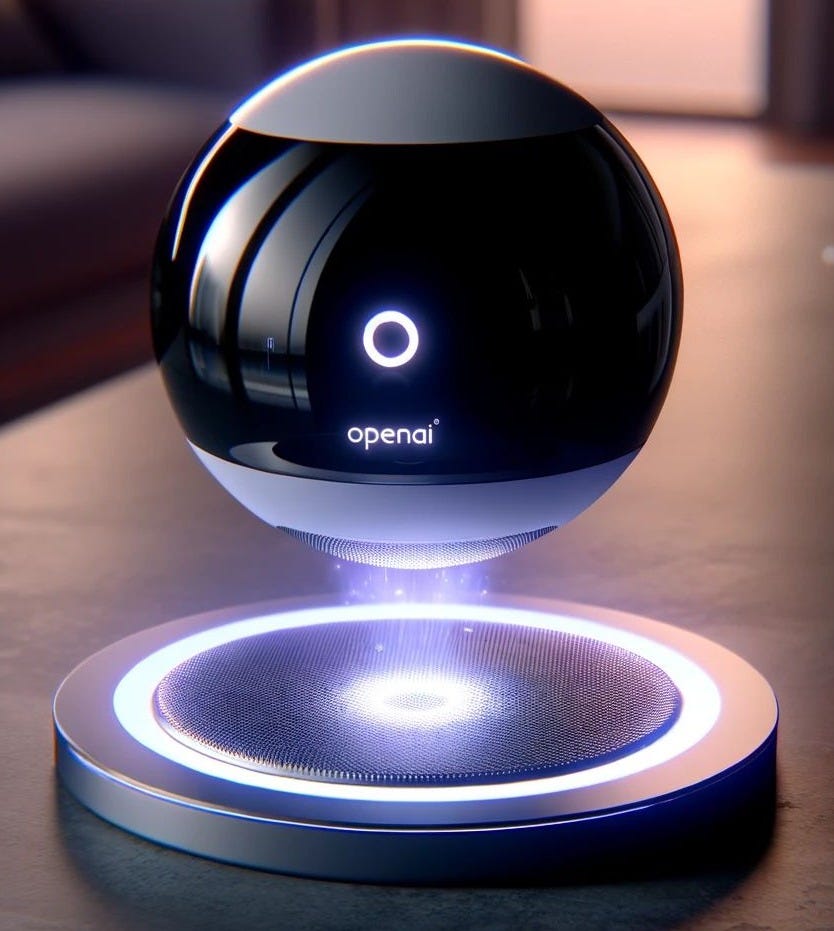
The smart speaker OpenAI is developing with Jony Ive has a camera that enables it to take in information about its users and their surroundings items on a table, conversations happening nearby.
The device, according to internal presentations, will observe users and suggest actions to help them achieve goals such as suggesting an early bedtime ahead of a morning meeting.
That is not reactive AI.
That is proactive AI. AI that sees, learns, and acts before you ask.
And that gap from reactive to proactive is the gap OpenAI just spent $6.5 billion to close.
Part Two: The Strategic Move Everyone Missed
To understand why OpenAI made this move, you have to understand the position the company was actually in before it did.
OpenAI has nearly a billion weekly users of ChatGPT.
That is an astonishing number.
It represents one of the fastest-adopted technologies in history.
And yet, OpenAI doesn’t own the relationship with a single one of those users.
OpenAI has to rely on other devices and platforms for distribution.
Every time someone opens ChatGPT on an iPhone, they’re doing it inside Apple’s hardware, on Apple’s operating system, subject to Apple’s rules.
Apple owns the entry point. OpenAI is a guest.
This is what strategists call the Tenant Problem.
You can build an incredible product, capture enormous user love, generate real revenue and still be dependent on someone else’s infrastructure to reach your customer.
That dependency is a ceiling.
And ceilings have a way of becoming problems when the landlord decides to compete with you.
Apple is already building its own AI. Google has had AI embedded in Android for years.
The platforms that OpenAI relies on to reach users are the same platforms most likely to want to replace them.
By acquiring Jony Ive’s startup io in May 2025 MacRumors, OpenAI made a decision: stop being a tenant. Build your own house.
As Sam Altman and Jony Ive described it: tentative ideas and explorations evolved into tangible designs.
It became clear that their ambitions demanded an entirely new company.
That “entirely new company” is now the most closely watched hardware project in technology.
And what it’s building will tell us what the next era of intelligence looks like.
Part Three: What the Device Actually Is (And What It Isn’t)
Let’s be specific, because the details matter.
OpenAI’s first device a smart speaker with an integrated camera is priced between $200 and $300 and is planned for launch no earlier than February 2027.
It includes facial recognition similar to Face ID and will allow users to make purchases through the device directly.
Sam Altman has described the device as more “peaceful and calm” than an iPhone, and users will apparently be shocked at how simple it is.
Beyond the smart speaker, OpenAI is also exploring a smart lamp and smart glasses, though those won’t be ready until 2028 or later.
There is also a screen-free wearable codenamed “Sweetpea” possibly earbuds in development.
The device has already been delayed once originally scheduled to launch in 2026, it has now slipped to no earlier than February 2027.
There have also been reported internal tensions between Ive’s LoveFrom design company, which has remained separate from OpenAI, and the internal hardware and software engineering teams.
So let’s be honest: this is not a finished product sitting on a shelf.
It is a vision in progress, with real engineering challenges and real organizational friction behind it.
But here’s what the skeptics are missing when they focus on the delay or the internal politics.
The delay doesn’t matter. The vision does.
Because what OpenAI is building whether it ships in 2027 or 2028 or takes three more tries to get right is not a smart speaker.
It’s an entirely new category of relationship between humans and intelligence.
And once that category exists and works, the old one doesn’t come back.
Part Four: The Sensor Layer, Why a Camera Changes Everything
The most significant detail in everything that has leaked about this device isn’t the price, the timeline, or even the Jony Ive connection.
It’s the camera.
Current AI even the most advanced systems available today is functionally blind.
It knows what you type. It knows what you say. It does not know what’s in front of you.
That creates an enormous gap between what AI can do and what intelligence actually requires.
Real intelligence isn’t just about processing language. It’s about understanding context.
What’s happening in the room. What objects are present. What’s changed. What the situation actually is not just what you’ve described.
A camera closes that gap.
An AI that lives alongside users, with personal context-awareness, shapes expectations for how intelligence is distributed across an environment enabling better timing, smarter automation, and a higher bar for what intuitive actually means.
It this looks like in practice. Today, you ask an AI what to cook for dinner. It gives you a recipe.
Tomorrow, an AI with a camera sees what’s in your kitchen the half-used vegetables, the protein in the fridge and suggests a meal before you think to ask.
Today, you ask an AI to help you prepare for a meeting.
It summarizes the document you share.
Tomorrow, an AI with persistent context has been present in your environment for weeks.
It knows your patterns, your workload, your habits.
It doesn’t wait for you to ask.
This is what transforms AI from a tool you use into an intelligence that participates.
Where the iPhone consolidated digital life into a glowing rectangle, the OpenAI device seeks to decentralise technology into the environment through invisible interface abstracting away the complexity of the digital world via an intelligent agent that understands the physical world as fluently as it understands code.
That’s not an upgrade to the smartphone era. That’s a replacement of it.
Part Five: The Context Economy, Who Wins When AI Sees Everything
When the interface changes, the economy changes with it.
The smartphone created the App Economy.
The screen became the surface on which billions of dollars of value was built apps, ads, subscriptions, attention.
If the ambient device succeeds, it creates something different. Call it the Context Economy.
In the current model, the value chain works like this: you feel a need, you search, you click, you buy.
Google and Amazon sit in the middle of that chain and extract enormous value from every step.
In the Context Economy, that chain collapses.
The AI doesn’t wait for you to search.
It anticipates the need and facilitates the action directly, without a search engine, without an ad, without an intermediary.
OpenAI’s hardware threatens to bypass the App Store economy entirelym, an architecture where the LLM acts as the kernel, managing user intent and context rather than traditional files, treating the entire internet as a set of tools for the AI rather than a collection of destinations for the user.
The implications for every existing platform business are significant.
Search becomes secondary when you no longer need to search when the AI already knows what you need and surfaces it without prompting.
The ad model that has funded the internet for twenty years depends on the gap between desire and fulfillment.
Ambient AI closes that gap.
Retail websites become fulfillment back-ends when the AI is the primary shopping interface.
The brand relationship shifts from the platform to the intelligence layer.
Apps themselves become invisible infrastructure services the AI calls upon in the background, rather than destinations users navigate to.
This is not a distant future.
OpenAI is already targeting 40 to 50 million units in its first year of sales.
The infrastructure for this shift is being built right now.
Part Six: The Trust Problem , The Obstacle No One Can Engineer Away
Here is where we have to be honest about the hardest challenge in this entire story.
None of it works without trust.
A device with a camera and microphone, sitting in your home or on your body, observing your environment and learning your patterns that is genuinely powerful.
It is also genuinely alarming to a large portion of the population.
To move from niche to widespread use, AI wearables must respect privacy so as not to alienate the people around us.
The winners will have both excellent hardware and social grace.
This is where Jony Ive’s role becomes more than aesthetic.
Ive and Altman have described the device as something that “makes people feel joy” and functions as a “peaceful, active participant” that isn’t annoying.
These words are doing a lot of work.
They are not describing technical specifications. They are describing an emotional design challenge.
The device has to feel trustworthy before it is trusted. And trust in consumer technology is not built through feature announcements.
It’s built through design through the way something looks, feels, and behaves over time.
Ive’s philosophy has always been that great design makes the technology disappear.
The product becomes part of your life rather than an intrusion into it. A lamp. A speaker. An object that belongs in the room.
This is what’s described as “calm computing” by removing the screen, the device forces a shift towards high-intent interactions, reducing time spent in the addictive loops of modern smartphones.
Whether this philosophy survives contact with a public that is increasingly cautious about AI in their physical space is the open question.
How users will react to a device designed to ingest and analyze vast amounts of potentially intimate data remains to be seen.
Consumers are already growing wary of AI, fearing a new era of surveillance.
This is the tension at the heart of the entire project.
And it’s a tension that cannot be resolved in a lab.
It will be resolved or not by real people, making real choices, in real homes and real lives.
Part Seven: What the Failure History Tells Us
It’s worth pausing to acknowledge that this is not the first time someone has tried to build ambient AI hardware.
The graveyard is visible.
Humane’s AI Pin launched with enormous hype and collapsed almost immediately, overheating, poor battery life, a camera that felt invasive, and a value proposition that the phone in your pocket already covered better.
Rabbit’s r1 was a similar story.
Smart home speakers from Amazon and Google have been around for years, and while they’re useful, they haven’t changed behavior at the level OpenAI is describing.
Until now, there hasn’t been a standout AI device success story. The Humane AI Pin got sold to HP.
So why should this be different?
The honest answer is: it might not be. The delay is real. The internal friction is real. The trust problem is real.
But there are three things that distinguish this attempt from everything that came before.
First, the model quality. Previous AI hardware was constrained by the intelligence behind it.
The gap between what the device promised and what it could deliver was too wide.
The model capability now available to OpenAI is in a different category from what Humane or Rabbit were working with.
Second, the design ambition. Jony Ive has designed more category-defining products than anyone alive.
His involvement is not a marketing decision.
It reflects a genuine belief that the interface problem is fundamentally a design problem, and that it requires someone who has solved design problems at this level before.
Third, the distribution infrastructure.
OpenAI has nearly a billion weekly ChatGPT users.
No previous AI hardware company launched with that installed base of trust and familiarity. OpenAI doesn’t have to introduce itself.
It has to introduce a new form factor to people who already believe in the underlying intelligence.
That’s a meaningfully different starting position.
Part Eight: The Deeper Stakes , What Happens to Us
We need to talk about something the product announcements don’t.
What does it do to human judgment when a layer of proactive intelligence is woven into the environment around us?
This is not a science fiction question.
It’s an organizational and psychological question that is already relevant.
We have already lived through one version of this transition.
Smartphones gave us access to unlimited information at all times.
The result was not a generation of deeper thinkers.
It was, in many ways, a reduction in tolerance for uncertainty because uncertainty could always be resolved by reaching for the phone.
Ambient AI takes this further.
If the system is anticipating your needs before you articulate them, you are not just outsourcing the search. You are outsourcing the noticing.
For individuals, the question is whether they remain the authors of their own attention or whether that attention is gradually shaped by what the system decides to surface.
For organizations, the question is governance.
When an ambient AI layer is operating inside an enterprise environment, observing workflows, suggesting actions, facilitating decisions who has defined what it’s optimizing for? Who is watching it? Who owns the outcome when it gets something wrong?
To avoid the loss of human autonomy, the design philosophy must extend beyond physical materials to the very logic of the interaction creating interfaces that are transparent about their reasoning, that provide clear opt-out mechanisms, and that prioritize long-term wellbeing over short-term convenience.
That principle applies not just to consumer devices. It applies to every intelligent system being deployed in any environment where real decisions are being made.
The ambient era is coming. The governance question is whether the humans inside it remain its architects or gradually become its subjects.
Part Nine: The Executive Framework , Five Things to Watch
If you are thinking about this as a leader in any industry here is what to track.
1. The interface is the prize.
In any system, the entity that controls the point of contact between humans and intelligence controls the value.
The smartphone made this true for the last twenty years.
Ambient AI will make it true for the next twenty.
Every strategic decision about AI in your organization should start with this question: where is the human-intelligence interface, and who controls it?
2. Context is the new competitive moat.
The organization that understands the real operational context of its environment in real time, continuously will out-decide the one working from yesterday’s data and last quarter’s reports.
This is true at the consumer level. It is equally true inside high-risk industrial operations.
3. Proactive beats reactive in every domain.
The shift from AI that answers to AI that anticipates is not just a consumer product story.
It’s the same shift happening in safety intelligence, risk management, workforce optimization, and operational decision-making.
The organizations that build proactive capabilities now will have a structural advantage that is very hard to close later.
4. Trust is infrastructure.
You cannot deploy ambient intelligence in a consumer product or an industrial system without the trust of the people inside it.
Trust is not a PR problem. It is a design problem. It requires transparency, governance, and consistent behavior over time.
Organizations that treat trust as an afterthought will pay for it.
5. The governance gap is the real risk.
OpenAI is planning to ship 40 to 50 million units in year one of a device that will sit in people’s homes, watch their lives, and make proactive suggestions about their behavior.
The governance frameworks for this at the regulatory level, the organizational level, and the individual level are nowhere near ready.
That gap between deployment speed and governance readiness is the defining risk of the ambient era.
And it is identical, in its logic, to the governance gap that exists right now inside industrial operations deploying AI into safety-critical environments.
In both cases, the technology is moving. The oversight is catching up.
The leaders who close that gap first not by slowing down the technology, but by building the governance to match its pace are the ones who will define what comes next.
The Final Word
Here is how to think about this entire story.
OpenAI paid $6.5 billion not for a product. It paid $6.5 billion for a position, the right to sit between human attention and the intelligence that shapes it.
Sam Altman described the ambition simply: a device that is more “peaceful and calm” than the smartphone, that users will be shocked to find so simple.
Simple is hard. Peaceful is hard. Ambient is hard. And trust, at scale, in a camera-equipped AI that lives in your home, that is the hardest problem of all.
But the direction is clear.
The infrastructure is being built. The investment is committed.
And the companies that understand the implications of that shift not just the technology, but the governance, the human psychology, and the organizational design questions it raises will be the ones that thrive inside it.
The smartphone era taught us that the device in your pocket shapes how you think.
The ambient era will teach us what happens when the intelligence is no longer in your pocket.
It’s in the room.