

Most companies talk about AI like it’s a plug-and-play upgrade, an add-on, not a transformation.
But AI doesn’t slip neatly into existing structures.
It exposes them.
Below is a fast, grounded way to assess whether your organization is actually ready to deploy AI at scale not the marketing version, the operational one.
1. The Strategic Spine: Is There a Real “Why”?
AI readiness begins with intent.
Not, “We need AI to stay competitive,” but,
“Where does intelligence actually create leverage in our workflows?”
If leaders can’t identify specific use cases tied to real pain points, the strategy is not ready it’s aspirational.
A mature organization can articulate three things clearly:
the problem it wants AI to solve
the measurable outcome it expects
the risk boundaries it refuses to cross
Without this spine, everything else wobbles.
2. Data Reality Check: Are You Feeding the System Noise or Signal?
Every company claims to be data-rich.
Most are data-chaotic.
AI readiness means knowing:
where your data lives
whether it’s clean
whether it’s complete
whether it’s governed
If you don’t trust your own data, you’re not ready for AI because AI will amplify whatever you give it, good or bad.
This is where most organizations discover their first real bottleneck.
3. Operational Maturity: Can Your Processes Absorb Intelligence?
AI doesn’t drop into a vacuum.
It lands inside existing systems: maintenance routines, approval workflows, supply chains, safety protocols.
Ask:
If the AI gives a recommendation at 2:17 p.m., what exactly happens next?
If the answer is unclear, or if the process can’t adapt quickly, readiness is low.
AI reveals process fragility long before it delivers value.
4. Governance & Risk: Do You Have Guardrails or Good Intentions?
Regulators won’t care how excited you were about AI.
They’ll care about documentation, controls, auditability, explainability, and accountability.
An AI-ready organization has:
decision logs
model oversight
risk classifications
escalation paths
human-in-the-loop definitions
If these don’t exist, you’re not ready , you’re exposed.
5. Workforce Adaptability: Are People Ready to Work With Intelligence?
You can deploy the smartest system in the world, but if your people don’t understand how it changes their workflows, you’ll get fear, resistance, or misuse.
Readiness isn’t technical.
It’s cultural.
The workforce needs clarity:
What decisions stay human? What shifts to the system? What skills matter now?
The Quick Summary
AI readiness is not a score.
It’s a mirror.
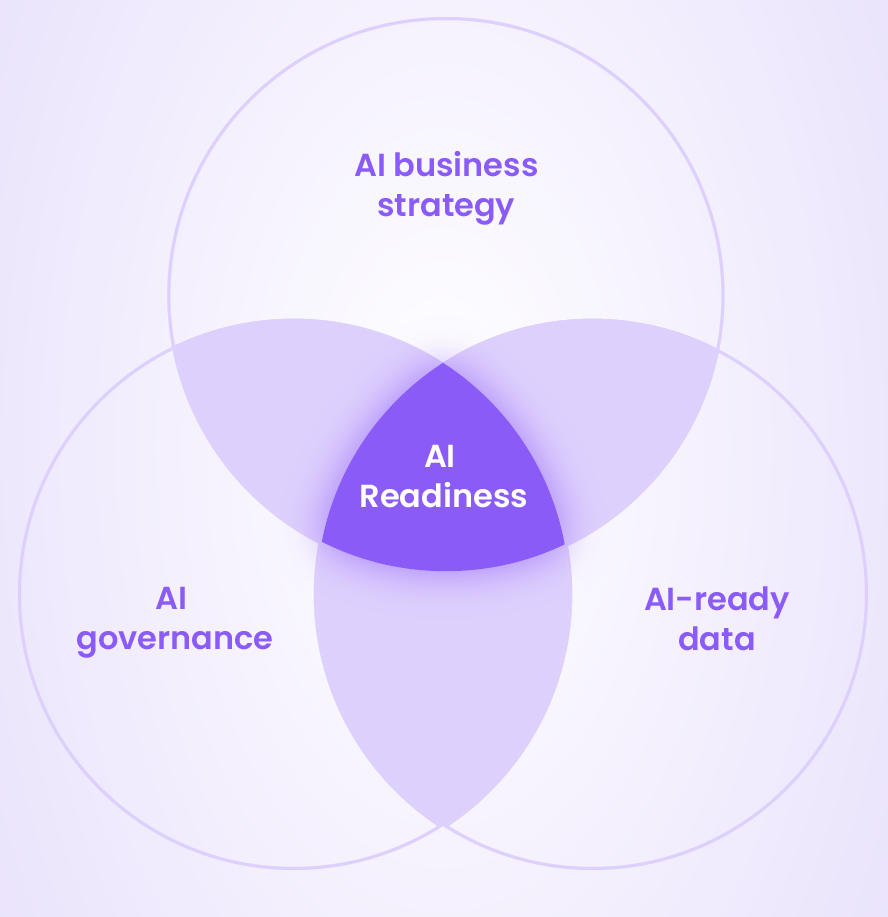
It reveals whether your strategy is grounded, your data is trustworthy, your processes are resilient, your guardrails are real, and your people are prepared.
If any one of these fails, the deployment will fail with it.
Fix the foundation first.
Acceleration comes after.