

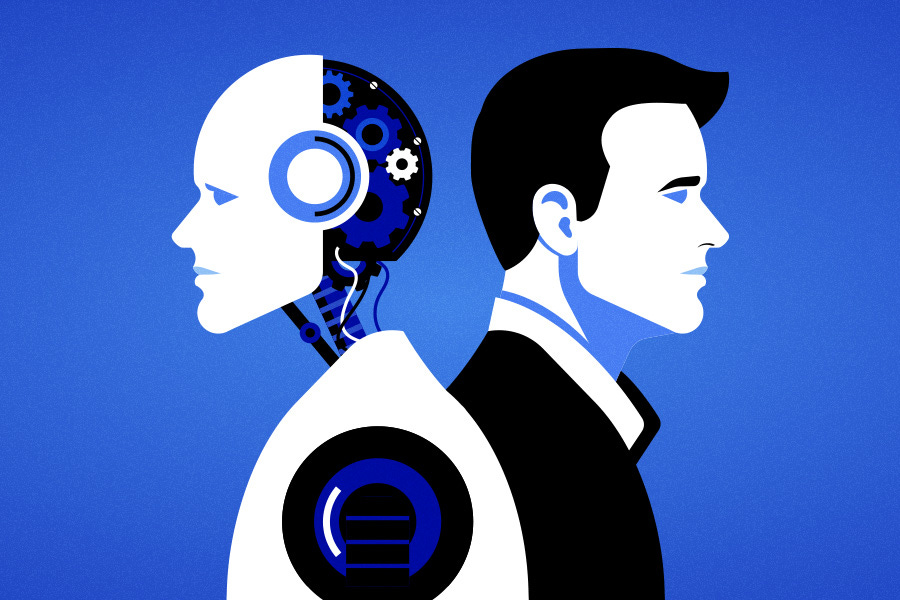
There’s a distinction most organizations haven’t processed yet and it’s the one that changes everything about how enterprises will be structured in the next five years.
AI assistants help workers.
Digital coworkers replace entire workflow loops.
That’s not a subtle difference.
That’s a different category of technology and a different category of business problem.
The Threshold Nobody Talked About
Most people have been interpreting AI tools as better interfaces.
Faster. Smarter. More helpful.
And that framing is accurate right up until the moment it isn’t.
AI becomes a digital coworker the moment it stops requesting your supervision and starts closing loops on its own.
Assistants inform. Operators act.
Claude-based systems are now performing multi-step tasks across enterprise applications, retaining context over long sessions, and operating semi-autonomously inside workflows.
This is the first credible jump from AI as a tool to AI as an operator.
And it’s happening years earlier than most enterprise roadmaps anticipated.
Three Stages. Most Companies Are Misreading Which One They’re In.
Enterprise AI has followed a predictable arc.
In Stage 1, AI answers questions — humans remain the bottleneck.
In Stage 2, AI executes tasks but requires human oversight at every step.
In Stage 3, AI handles workflows autonomously within defined boundaries, surfacing only exceptions for human decision.
Stage 3 is no longer theoretical. It’s running inside real organizations right now.
The enterprises that recognize this early will redesign around it.
The ones that don’t will wonder why their competitors are scaling without adding headcount.
What Changes Systemically
When AI becomes an operator rather than a helper, three pressures emerge simultaneously.
Workflow sovereignty: organizations now need to decide explicitly which workflows humans own and which AI operators control.
That decision has legal, cultural, and operational consequences most leadership teams aren’t ready for.
Liability transfer: once AI executes tasks autonomously, the accountability model has to be rewritten.
Who owns the outcome when no human made the call?
Internal performance gaps: teams that integrate AI operators will outpace teams relying on manual workflows. This doesn’t happen gradually. It happens fast, and it widens.
The Practical Question to Ask Right Now
If you want to identify where digital coworkers will land first in your organization, don’t map your tasks. Map your friction.
Ask: which workflow produces the most damage when it’s delayed, inconsistent, or dependent on a single person?
Those workflows , high frequency, high consequence, error-compounding are where AI operators deliver immediate and measurable value.
That’s not a technology question. It’s an operational one.
And it’s one every leader should be able to answer before their procurement team answers it for them.
Digital coworkers aren’t a product feature.
They’re the blueprint for the next enterprise operating model.
The organizations that treat them as a pilot will eventually report to the ones that treated them as infrastructure.