

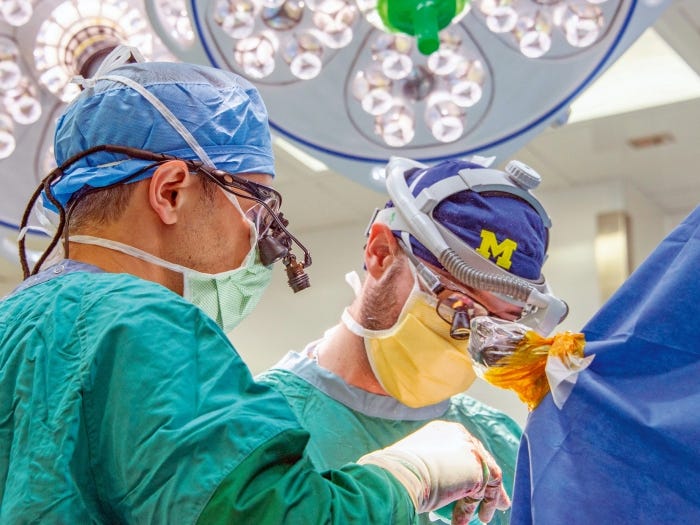
Researchers at the University of Michigan just built an AI that can read brain MRI scans in seconds.
And not just skim them.
Interpret them.
It can spot early signs of stroke, subtle bleeding, even the faint outline of a tumor and flag urgent cases almost instantly.
Now, a seasoned radiologist might spend hours reviewing the same stack of images.
So, when you hear that comparison, it’s natural to feel a little uneasy. It sounds like a replacement story.
But that’s not really what’s happening.
Let me explain.
The system was trained on hundreds of thousands of brains scans normal cases, emergency cases, everything in between.
Over time, it learned to recognize patterns most of us would never see.
Tiny irregularities. Slight asymmetries. Signals so faint they blur into background noise, especially if you’re ten hours into a hospital shift.
The AI doesn’t get tired.
It doesn’t hurry to finish rounds. It doesn’t lose focus because it’s 2 a.m.
But speed is not the real breakthrough here.
The important part is this: it knows when it’s not sure.
When the system’s confidence drops below a certain threshold, it flags the scan for a human to review.
It doesn’t guess. It doesn’t bluff. It defers.
That design decision changes everything.
Most AI failures don’t happen because a system makes a mistake.
They happen because it makes a mistake confidently and no one catches it in time.
This one was built to hesitate.
And in medicine, hesitation is never weakness. It’s judgment.
When decisions affect real lives, the most important signal might not be certainty.
It might be knowing exactly where your certainty ends.